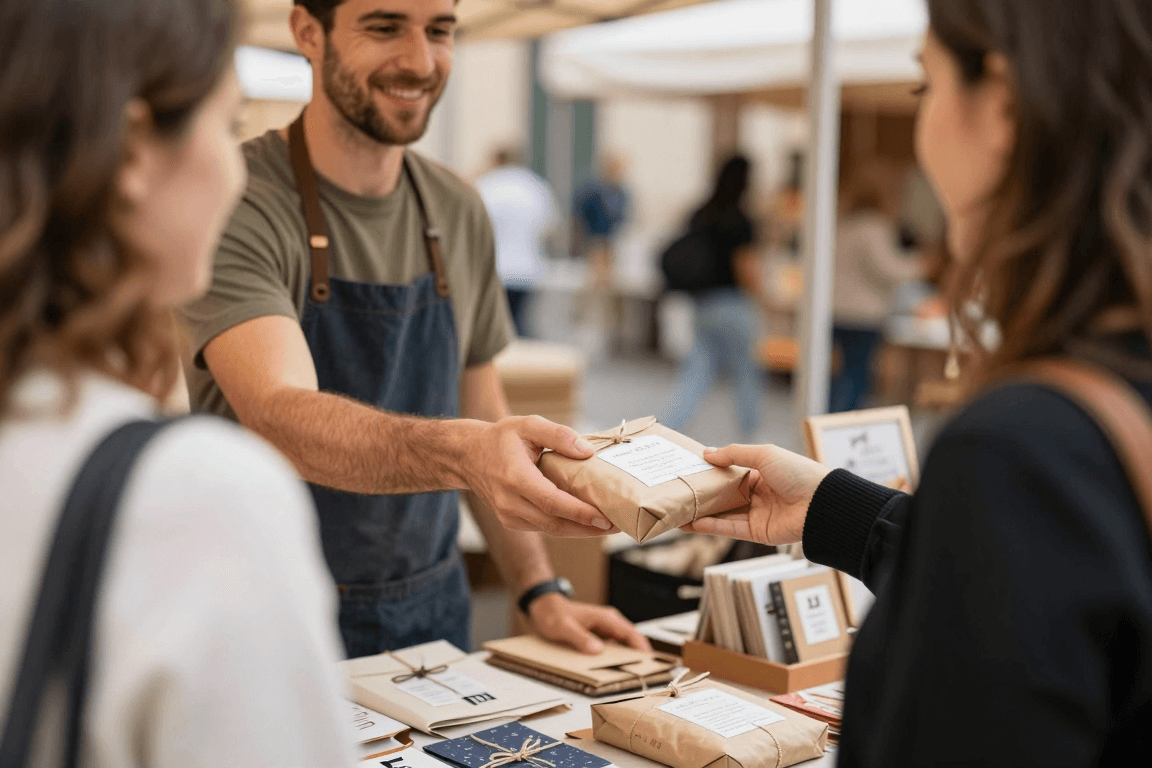
Acquiring a new customer costs five to seven times more than selling to someone who already bought. That gap is wide enough to build a business on — but only if you treat the first purchase as the start of something, not the end of it.
Most sellers do the opposite. The transaction closes, the confirmation email goes out, and attention immediately shifts to finding the next stranger.
The moment after payment is the most underused moment in a small seller's operation. Most sellers send an order confirmation and disappear. The ones who build something lasting do something different in that window — not a lot, and not complicated. But intentional.
The Numbers Behind Repeat Buyers
These numbers come from medium-sized e-commerce operations, but the dynamics scale down. A ceramics seller getting two repeat orders a week does not need to acquire two new customers a week to maintain that. The economics shift in your favour quickly once you stop treating every sale as a one-time transaction.
What "Community" Actually Means at Small Scale
The word community makes most solo sellers think of a Discord server, a Facebook Group, a Slack workspace — something that requires regular moderation, content, and energy they do not have.
That is not what this is about.
At small scale, community is not a platform. It is a feeling. A returning customer who feels remembered, appreciated, and treated like a person rather than an order number — that is community. You do not need software for it. You need intention.
A buyer who has already solved their "can I trust this seller?" problem is the most valuable person you have. The question is whether you give them a reason to come back.
The solo seller advantage here is real. Large brands cannot do what you can do. They cannot remember that Maria from Lisbon bought the blue version because her daughter's birthday was in March. They cannot send a personal follow-up that actually sounds personal. Their "personalisation" is a mail merge field in a CRM. Yours can be a genuine note.
The Post-Purchase Sequence
This is the practical part. A sequence is just a series of intentional touchpoints after the sale. None of these require email software or automation until your volume makes manual follow-up impractical.
The order confirmation is expected. The personal note is not. One or two sentences addressed to the buyer by name, written like a person wrote it. "Thanks for the order, putting yours together today" is worth more than any template.
This does not require a separate message if your confirmation system lets you customise the text. If it does not, a short follow-up message sent manually takes two minutes and is remembered.
Three to five days after the expected delivery date, a short message: "Hope it arrived safely — let me know if you have any questions." This catches any delivery issues early and shows you care what happens after the money moves.
Most buyers never get this. The ones who do remember it.
This is the one most sellers skip, and it is the one that generates repeat purchases. Around 30 days after delivery, the buyer has used the product, formed an opinion, and is warm toward you again.
A simple message: "Hope you've been enjoying it. Let me know if you ever want another — happy to send you a link." No discount required. No pressure. Just the reminder that you exist and that buying again is easy.
If someone responded positively to any of the above, they are a candidate for a referral ask. Not a formal "refer a friend and get 10% off" program — just: "If you know anyone who might like this, feel free to pass the link along."
This sentence, in a follow-up message, generates word-of-mouth. Not dramatically, but steadily. A seller who gets one referral per dozen orders is running a more efficient business than one spending on ads for the same result.
The Solo Seller Advantage
Large sellers are running playbooks designed for thousands of customers at a time. Those playbooks require everything to be automated, segmented, and templated. That is their constraint. It is your opportunity.
The difference is not scale of effort. The five-step sequence above takes minutes per order. The difference is intention. Most solo sellers do not do it because it feels small or unnecessary. It is neither.
When Volume Makes This Harder
At very low order volume — under 30 orders a month — all of this is easy to do manually. The question becomes: what happens when it is not?
The answer is not to stop doing it. It is to systematise it without losing the tone.
A basic email tool — Mailchimp, Brevo, ConvertKit — can send timed follow-up sequences automatically, with enough personalisation fields to keep them feeling real. The goal is not to automate the warmth out of your follow-ups. It is to make sure the follow-up happens even when you are busy.
Most sellers reach this threshold somewhere between 50 and 150 orders per month. Before that, doing it manually is faster to set up and often more effective.
What Builds Loyalty Without Any of This
The tactics above work. But the foundation of repeat business is simpler than any tactic.
Buyers come back when the product was what they expected, the purchase was easy, and they felt like their business was valued. That is it. Every piece of advice in this post is amplifying that foundation, not replacing it.
Fix the product and page problems first. Use the post on refund data to close the expectation gaps. Fix the friction in your checkout. Then add the follow-up sequence on top of a clean base. In that order.
Community is not something you build once. It is something that accumulates slowly from a hundred small, intentional interactions — most of them invisible to anyone watching from outside.