





There is a version of this post that is about tactics: "send an abandoned cart email within one hour, offer 10% off, use urgency." That version is fine. But it skips the more interesting question: why did they leave in the first place?
Abandoned carts and returns are not random. They follow patterns that are specific to your product, your page, your messaging, and your price. When you can read those patterns, you fix the underlying cause rather than chasing symptoms.
This post is about the underlying causes.
Why People Abandon: It Is Rarely About the Price
The instinct when someone abandons is to assume price was the problem. Sometimes it is. More often it is not.
Studies of checkout abandonment consistently show that the top reasons are:
- Unexpected information at checkout (shipping cost, taxes, delivery time)
- Not ready to buy yet (browsing, not deciding)
- Account creation requirement
- Payment method not available
- Page felt untrustworthy at a critical moment
Price objection - "too expensive" - accounts for a smaller portion than most sellers assume. When price is genuinely the issue, it usually shows up as no purchases at any volume, not as abandoned carts.
An abandoned cart means someone was interested enough to click through to checkout. That is further than most visitors get. Losing them there is a specific, solvable problem.
The Trust Drop: Where It Happens
For independent sellers, the most common abandonment trigger is a trust drop at checkout. The buyer was interested on the product page, but something at the transition to payment made them hesitate.
Trust drops happen when:
- The checkout page looks visually different from the product page (signals a third-party handoff they were not expecting)
- There is no visible return/refund policy
- The payment options are limited (no card, no PayPal, no common local method)
- Delivery time is not stated anywhere until checkout
- The total price changes from what they saw on the product page
Fixing trust drops does not require redesigning anything. It usually requires adding three pieces of information that buyers need before they commit: delivery time, return policy, and total cost (including all fees) visible before the final payment step.
The "Not Ready Yet" Buyer
A meaningful portion of abandoned carts come from people who were never going to buy that session. They were researching, comparing, or bookmarking for later. This group is not lost - they are just not converted yet.
The signals that distinguish "not ready yet" from "trust problem":
- They added to cart and left immediately (price-checking, not hesitating)
- They visited multiple times before abandoning (comparing options)
- They left from the cart, not from the checkout (did not get far enough to hit a trust problem)
For this group, a follow-up message with a simple "still interested?" and no discount often works. They already wanted it. They just needed a moment and a nudge.
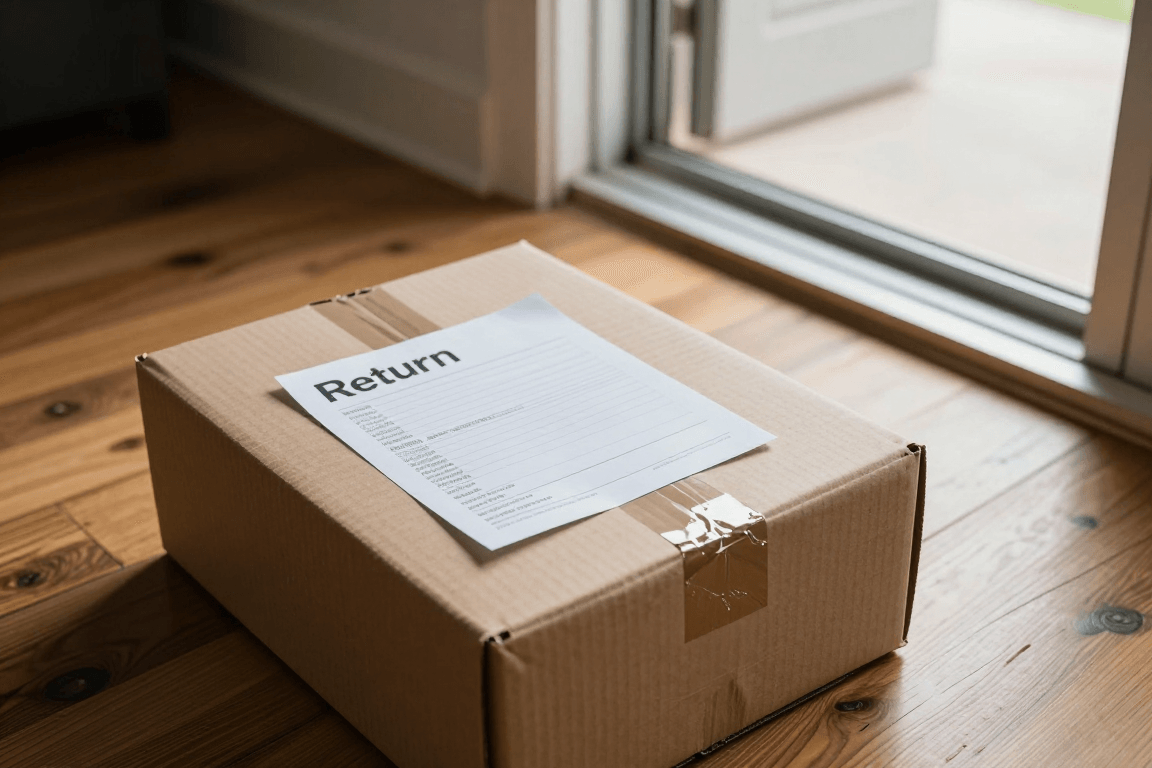
What Return Requests Actually Tell You
Returns hurt in the moment. They are also some of the most useful feedback you will ever get, delivered by people who cared enough to buy.
The patterns in return reasons are diagnostic. Different patterns point to different root causes:
| Situation | Diagnosis | Fix |
|---|---|---|
| "Not what I expected" | Product photos or description created a gap between expectation and reality | Add close-up photos, be specific about dimensions/materials, add a "what you'll receive" section |
| "Arrived damaged" | Packaging issue or carrier handling | Update packaging, add fragile labeling, consider carrier options |
| "Wrong size / fit issue" | Size guide missing or unclear | Add explicit size guide with measurements, add "when in doubt" size advice |
| "Changed my mind" | Often an impulse purchase that did not hold up on reflection, or unanswered pre-purchase question | Add FAQ section addressing hesitation points, clarify use case in description |
| "Does not work as described" | Description oversold a feature or capability | Rewrite with honest specificity, add limitations where relevant |
Acceptable Return Rates by Category
A return is not automatically a failure. Some return rate is normal and expected.
If your return rate is within normal range and the reasons are varied, this is not a problem to fix. If a specific reason repeats, fix that thing.
The Follow-Up Message That Works
For abandoned checkouts, a simple follow-up within 24 hours recovers a meaningful portion of "not ready yet" buyers. The message does not need to be elaborate.
If someone responds to the second version with a question, you get to answer it. That answer goes into your FAQ and prevents the next ten people from having the same hesitation.
Turning Patterns into Page Improvements
The most useful thing to do with abandonment and return data is not to recover individual sales. It is to improve the page so fewer people hesitate in the first place.
For returns, note the stated reason each time. For abandoned carts, note where in the funnel (cart vs checkout vs payment). After ten instances, look for patterns.
One page change that addresses a recurring reason will improve all future traffic, not just the people who already left. A better delivery time statement, a clearer size guide, a visible return policy - each of these converts better from the start.
After making a change, watch the return reason distribution for the next 20–30 orders. Did the pattern you fixed disappear? Did a new one emerge? Each improvement reveals the next thing to work on.
This is a slow loop. But it compounds. A page that has gone through three rounds of this improvement is significantly better than one that has not, even if the product and the traffic source are identical.
If you are working on your conversion rate more broadly, the post on what makes a single product page convert covers the full picture - abandonment and returns are symptoms, the product page structure is the root.