Upselling has a reputation for requiring a catalogue. Multiple products, bundle options, upgrade tiers — the implied rule is that you need more to sell more. That rule is wrong, and it keeps single-product sellers from trying something that would actually work for them.
There is a version of upselling that works with one product and no inventory complexity. It requires thinking about the purchase not as a transaction but as the beginning of a sequence.
Most buyers who have a good first experience would buy again. The question is whether you give them a reason to and make it easy when they do. Most sellers do not do either.
The Revenue Math Behind a Single Buyer
Before tactics, it helps to think about how much a single satisfied buyer is actually worth.
These numbers come from medium and large e-commerce businesses. At small scale the dynamics are similar, the margins just show up differently. A ceramics seller who gets one repeat buyer per week does not need to acquire 52 new buyers per week to maintain that income.
A buyer who has already bought from you has already solved their biggest objection: trusting you enough to pay. Every subsequent sale is easier than the first.
Upsell at the Point of Purchase
The highest-converting moment for an upsell is immediately after the purchase decision is made, before the buyer has left your page or closed their wallet mentally.
With one product, the upsell options at this stage are:
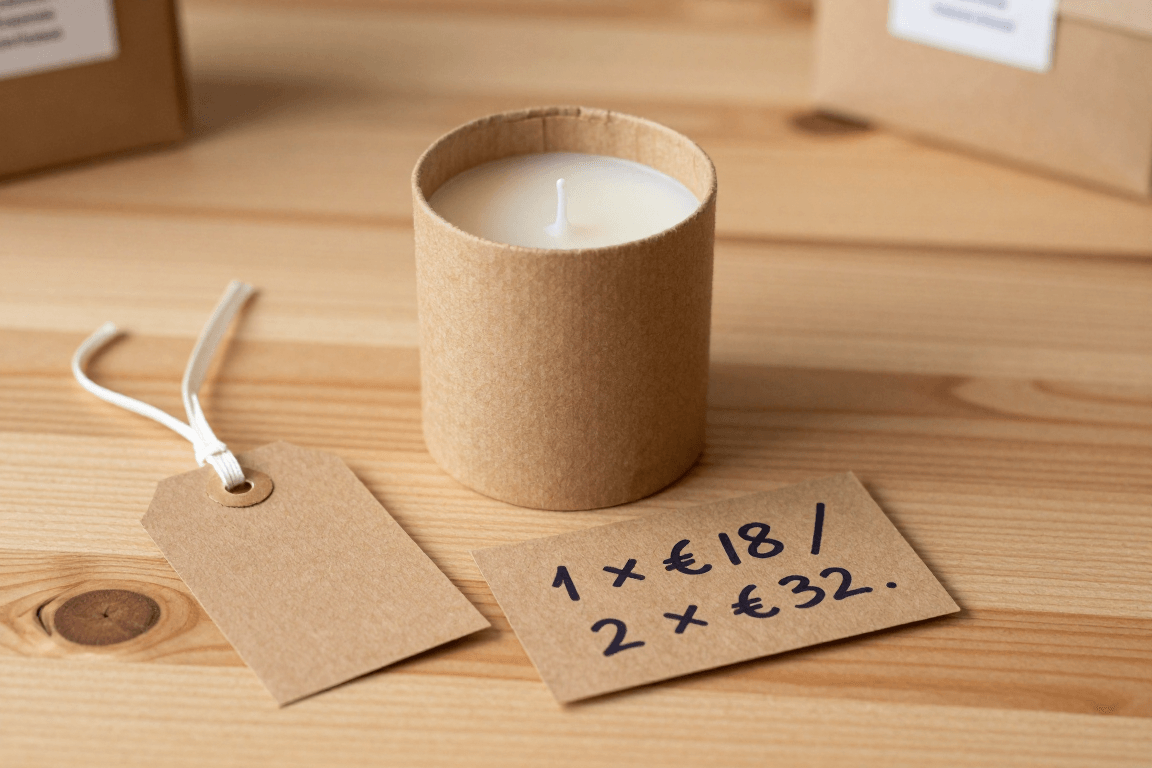
"Buy 2 and save 15%." Works especially well for consumables, gifts, and anything that gets used up or worn out. The buyer already wants one — the question is whether a small incentive makes two feel smart.
Thomas sells hand-poured soy candles. His single-candle price is €18. His "buy 2" price is €32 (saving €4). About 30% of his buyers take the two-pack, which nearly doubles the average order value without any additional product complexity.
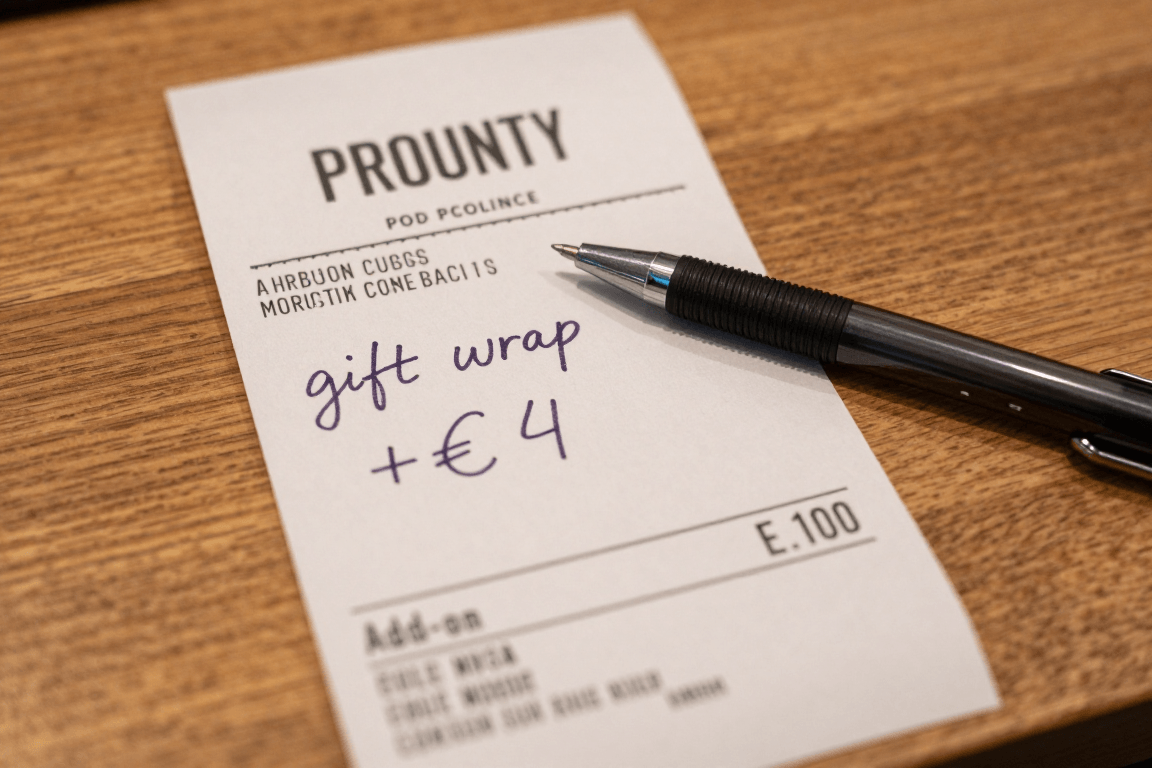
For physical products, a gift wrapping option at €3-6 converts particularly well in November-December and around gift-giving occasions. It is pure margin with minimal effort, and a meaningful percentage of buyers will take it because it solves a real problem (they were buying a gift).
A name, date, or short message added at €5-15 turns a standard product into a custom one. Buyers who want personalisation often would not have purchased the standard version — the option creates a sale that would not have happened otherwise.
For sellers with any production time, "skip the queue — ready in 24 hours for €8 extra" captures buyers who are buying under time pressure. This is a real segment, especially around occasions and holidays.
The Post-Purchase Sequence
The purchase is not the end of the opportunity. It is the start of the relationship that makes repeat revenue possible.
A basic post-purchase sequence for a one-product seller:
- Delivery confirmation with a personal note (not just "your order is confirmed")
- Follow-up 3-5 days after delivery: "hope you're enjoying it, happy to answer any questions"
- 30 days later: "if you loved it, here is an easy way to share it / here is a bundle offer / here is the next thing I made"
None of this requires email marketing automation. For sellers with fewer than 100 orders, personal messages work better. At higher volume, a simple email sequence in any free tool handles it.
The key is the 30-day message. Most sellers skip it. It is the one that generates repeat purchases and referrals, because it arrives when the buyer has used the product, formed an opinion, and is warm toward you again.
Bundles Without Extra Products
A bundle does not require different products. A bundle can be:
- Volume: three of the same thing at a discount
- Occasion: the same product positioned as a set ("a set of four for the table," "three for the office")
- Seasonal: "the summer edition" is the same product with seasonal packaging or a seasonal story
- Gift set: one product, wrapped, with a card — sold as a complete gift at a premium
The same handmade ceramic mug at €18 becomes a "gift set for two" at €42 (two mugs, gift box, tissue paper, small card slot). The buyer is not comparing the price per mug. They are solving a specific problem: finding a good gift. The bundle solves it cleanly.
Referrals as a One-Product Revenue Multiplier
The other underused lever with one product is referrals. A buyer who had a great experience is likely to tell someone. Most sellers make this harder than it needs to be by not asking.
The ask does not need to be a formal referral program. It can be as simple as:
"If you know someone who would love this, feel free to share the link. I appreciate every recommendation."
That sentence, in a post-purchase message, generates referrals. Not at a dramatic rate, but at a steady one. A seller who gets one referral per ten orders — at no acquisition cost — is running a more efficient business than one spending on ads for the same result.
For sellers with higher volume, a small referral incentive (€5 off the next purchase for the referrer when their friend buys) formalises the loop without requiring any complex infrastructure.
The Price Architecture Question
One thing worth thinking about before building upsell mechanics: do you have one price, or a price architecture?
A buyer who wants to spend more has nowhere to go in the first scenario. In the second, there is a natural path upward. Not every buyer takes it. The ones who do increase your average order value without any additional traffic.
We covered the psychology behind why higher prices sometimes convert better in the pricing psychology post — the same principles apply to upsell architecture.
What Not to Do
A few patterns that consistently underperform:
- Upselling aggressively at checkout (modal popups, multiple offers, delay tactics) — damages trust for first-time buyers
- Discounting too heavily for repeat buyers — trains them to wait for discounts rather than buy at full price
- Offering too many options at once — the more choices, the lower the conversion on any single one
- Treating the post-purchase period as the end of the relationship — it is the beginning
The mechanics above are all low-pressure and buyer-led. The buyer who wants the two-pack notices the option and takes it. The buyer who does not, does not see a pushy popup. That balance matters both for conversion and for the kind of brand reputation that generates repeat business.